


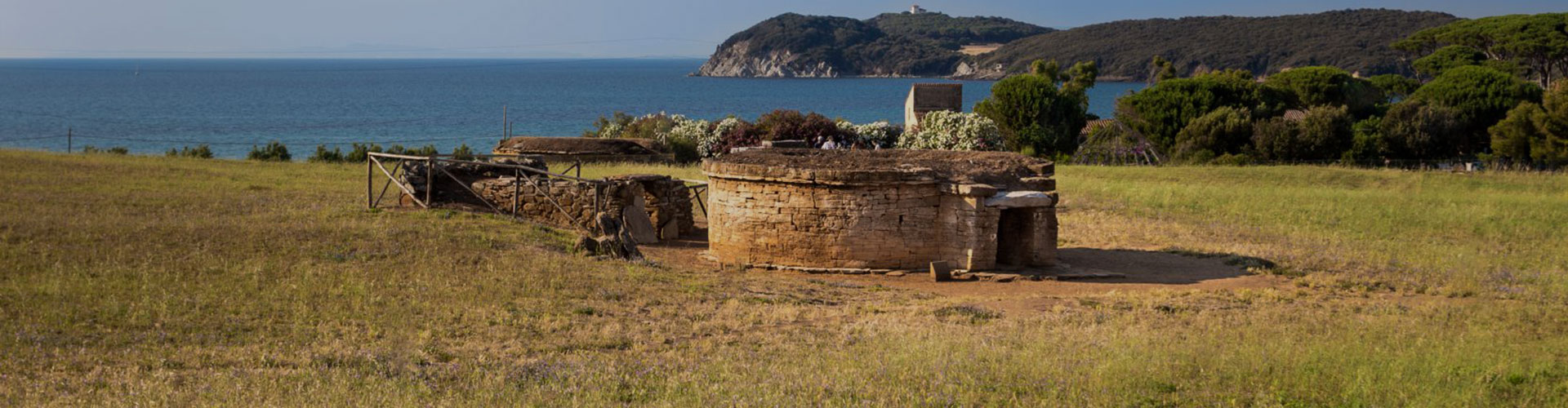
About Us
Our Mission
The Etruscan Foundation is dedicated to advancing the study, preservation, and appreciation of the art and archaeology of the peoples of the Italic peninsula and their connections to the wider world.
Through collaborative partnerships and innovative projects, the Etruscan Foundation aims to preserve their sites and artifacts for future generations while enhancing global awareness of their contributions to world history and the continuing connections to our present.
The Etruscan Foundation promotes public understanding, and educational initiatives that illuminate both past and present by providing fellowship grants, publishing the Journal of Etruscan and Italic Studies, and sponsoring lectures and symposia.
Fellowship Awards
In support of its educational mission, the Etruscan Foundation offers and sponsors a broad array of programs for its members and affiliates. These have included internship opportunities at the foundation’s Italian field headquarters, Tenuta di Spannocchia, fellowships and stipend awards in archeology and Etruscology, public lectures and scholarly seminars, and a variety of sponsored educational programs that have taken place in both Italy and in the United States.
Our Fellowship Awards
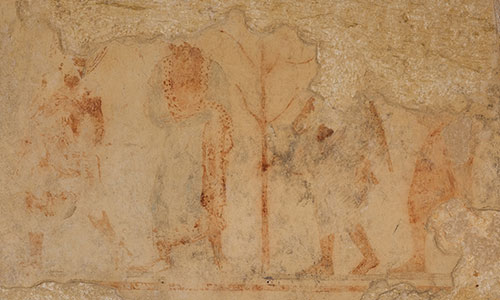
Cultural Heritage Preservation Award
The Etruscan Foundation Cultural Heritage Preservation Fellowship is designed to support the conservation or preservation of important Etruscan and Italic material culture that requires professional intervention for study, documentation, display, or simply consolidation.
Learn More and Apply
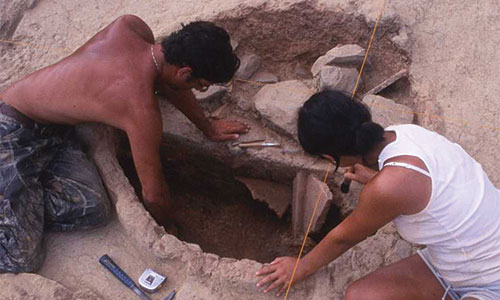
Fieldwork Fellowship
The Etruscan Foundation Fieldwork Fellowship is designed to support participation in field schools or archaeological fieldwork at Etruscan and indigenous sites of non-Greek Italy from the Neolithic through the 1st Century BCE.
Learn More and Apply
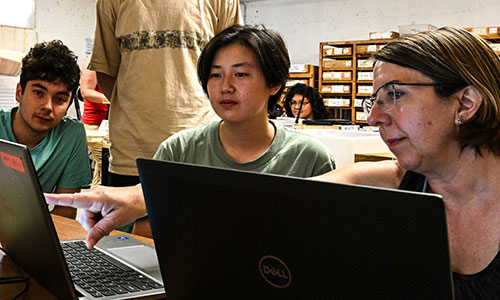
Research Fellowship
The Etruscan Foundation Research Fellowship is designed to support research in all areas of research on Etruscan and indigenous cultures of non-Greek Italy dating from the Neolithic through the 1st Century BCE.
Learn More and Apply
Conservation Fellowship
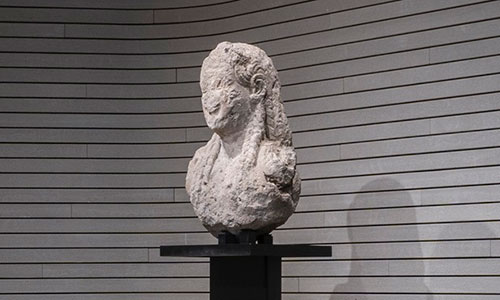
The Etruscan Foundation Conservation Fellowship is designed to support conservation in all areas of Etruscan and Italic sites of non-Greek Italy from the Bronze Age through the 1st Century BCE.
Learn More and Apply
Other Awards
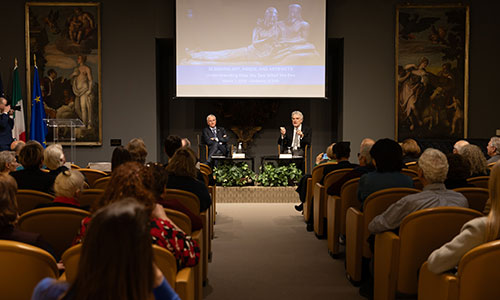
The Etruscan Foundation Conference Funding Award is designed to assist conferences in Canada and the United States that align with the Foundation’s mission statement to support the study and understanding of the cultural and material history and heritage of the Etruscans and Italic cultures.
Learn More and Apply
Annual Lecture
2026 Cinelli Lecture
Friday, April 10, 2026
Philadelphia, Pennsylvania
Following the Thread: Looking at Textiles in Etruscan Art
Gretchen E. Meyers, Ph.D., Franklin & Marshall College
Richly colored and elaborately composed textiles appear throughout Etruscan art—from painted tombs to cinerary urns and sculpted sarcophagi. These images show Etruscans not only dressed in brightly colored, intricate garments but also interacting with cloth as coverings and decorative elements: shrouds, wraps, blankets, and unfurled fabrics presented before assembled onlookers. The visual prominence of textiles in Etruscan material culture suggests that, as in many ancient societies, cloth was central to marking identity, status, and ritual.
This lecture will unpack the imagery of ancient textiles to explore how Etruscan craftspeople and viewers—especially elite women, well known in scholarly discourse for their skill in spinning and weaving—understood and participated in the cultural work of cloth. By focusing on the conventions used to represent material aspects of fabric, such as the depiction of folds, borders, and texture, we can see how images of textiles evoke the social and ritual contexts in which such materials were created and displayed. These include life-stage ceremonies such as marriage, death, and birth, as well as religious performances in which cloth served as both offering and medium. Both ancient and modern practices of cloth-making and presentation help us imagine how these depictions anchor the roles of creator and viewer in lost performances of ceremonial exchange—acts in which fabric literally and figuratively bound the social world together.
Additional event details will be emailed to Etruscan Foundation members.
Revisit this site in 2026 for more information
Tenuta di Spannocchia
A centuries-old estate in the hills of Tuscany, where organic farming and land conservation honor centuries of rural tradition. Once affiliated with the Etruscan Foundation and rooted in ancient Etruscan territory, Spannocchia continues to support education, research, and sustainable living.”
Our History
Supporting Etruscan research for over 50 years.
The Etruscan Foundation was established in 1959 by Ferdinand Cinelli as a non-profit organization to promote research and scholarly study of ancient Etruria, the region of Italy known today as Tuscany. Headquartered in Michigan, this American foundation sponsored its first archaeological campaign in 1958 at the ancient Etruscan city of Vetulonia, now recognized as a site of major historic and archaeological importance. Since that campaign, over sixty programs, co-sponsored by a series of American universities have excavated Paleolithic, Etruscan, Roman, and medieval sites.
Some of the more extensive field projects funded by the Etruscan Foundation since 1959 have been:
Vetulonia, 1958-60
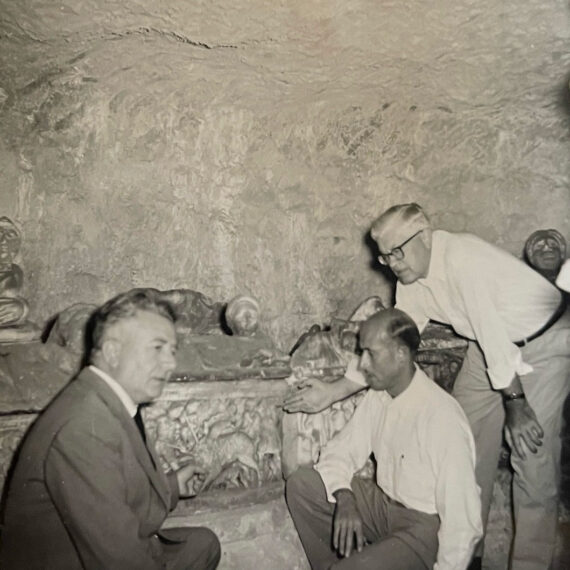
Vetulonia, 1958-60, directed by Dr. Anna Talocchini, University of Florence. The 1959 season concentrated on the tombs, among them the rich Tomb of the Silver Lions. In 1960, Dr. Talocchini changed the direction of the excavations to the study of the living instead of the dead; she undertook to clarify the topography of the ancient city. Work began on the north-south road and the western approach to the city. Vetulonia remains an important example of Etruscan urbanism, since it is one of relatively few Etruscan sites whose ancient structures and layout have been exposed. The report of these two campaigns appears in A. Talocchini, ” La città e la necropoli di Vetulonia secondo i nuovi scavi (1959-1962)” Studi Etruschi 31 (1963) 41-67, and “Le Orificerie ed il vasetto configurato del Circolo dei Leoncini d’Argento di Vetulonia,” Studi Etruschi 31 (1963) 67-89; and “The Golden Treasure and a Figured Jar from the Tomb of the Silver lions, Vetulonia,” Etruscans I (1967-69) 12-19.
Malignano (Poggio Luco), 1964 & 1965
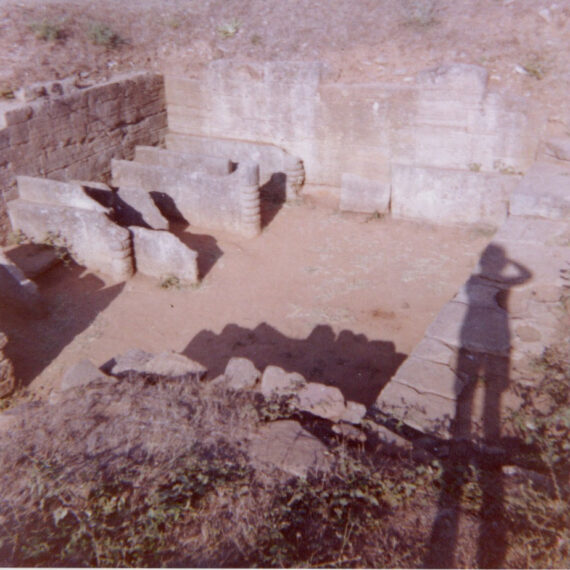
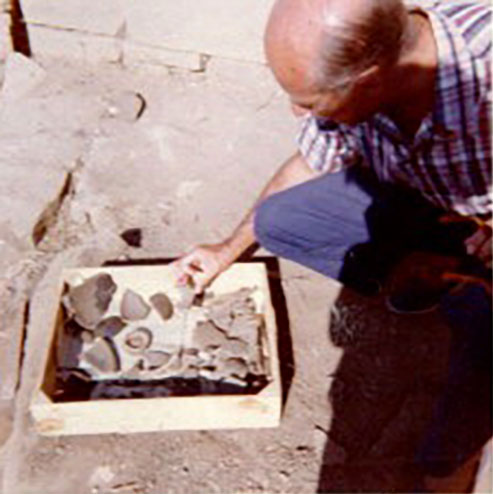
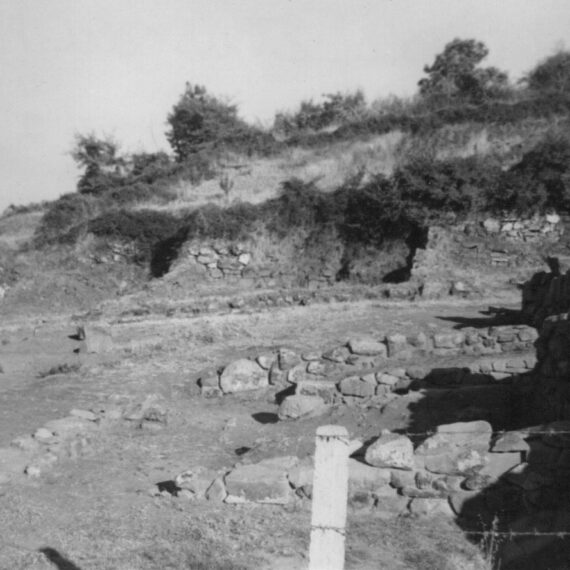
Dig at La Piana (1997)Malignano (Poggio Luco), 1964, directed by the late Prof. Kyle Phillips, then at the University of Michigan, later at Bryn Mawr College. The excavation of this Late Etruscan cemetery exposed one impressive chamber tomb and 18 smaller rock-cut tombs. All had been robbed in antiquity except for a few of the interior chambers, which yielded fragments of over 80 vessels and 52 coins. These coins indicate a period of use for the cemetery from the last quarter of the third century B.C. to the end of the second century B.C., a period of peace and development for the entire peninsula, between the expulsion of Hannibal from Italy and the first civil war between Marius and Sulla. This excavation led to Prof. Phillips’ historical reconstruction of the life of the Etruscan settlement served by these tombs.
Prof. Phillips returned to Malignano in 1965 to excavate the “Monumental Tomb.” Finds indicate that this tomb must have served a very well-to-do family, whose residence the team also sought without success during the season. The monumental tomb measures 17.5 m. in length and consists of a short entrance corridor leading into a large central hall with four connecting chambers. Black-glazed ware, worked bones, some large painted kraters, and fragments of decorated ivory were among the tomb furnishings. The material from Malignano is published in K.M. Phillips, Jr., “Relazione preliminare sugli scavi promossi dalla Etruscan Foundation di Detroit nella Provincia di Siena durante il 1964”, Notizie degli Scavi di Antichità XIX (1965) 5-29; and by the same author, “Excavations in the Province of Siena, 1964,” American Journal of Archaeology LXIX (1965) 172-73.
Papena, 1964
Papena, 1964, another cemetery of the Hellenistic Period roughly contemporary with Malignano, also excavated by Prof. Kyle Phillips. The recovered material was sparse but did provide valuable information on Late Etruscan settlement patterns between Siena and the metal-bearing mountains (Colline Metallifere) to the west. Papena is published in K.M. Phillips, “Relazione preliminare,” Notizie degli Scavi di Antichità XIX (1965) 5-29; and by the same author, “Papena (Siena). Sepultura tardo-etrusca,” Notizie degli Scavi di Antichità XXI (1967) 23-40.
La Befa, 1976-77
La Befa, 1976-77, a Roman villa excavated by Prof. John Dobbins of the University of North Carolina, now of the University of Virginia. Located near the warm springs of Petriolo, the villa flourished between the mid first century A.D. and the early fifth century. It included a large apsidal room and two hypocaust systems. This structure yielded many fragments of colored marble revetments that testify to the elegance of its appointments. The site provides useful evidence for the romanization and repopulation of this region after a period of widespread abandonment during the first century B.C. The full excavation report has been published as a monograph: John Dobbins, The Excavation of the Roman Villa at La Befa, Italy (Oxford, British Archaeological Reports: 1983); a preliminary report by the same author is published as “The Roman Villa at La Befa, Italy”, Archaeology XXXII,1 (1979) 58-60.
Petriolo, 1975-87
Petriolo, 1975-87, survey and excavation of Paleolithic period settlements along the river banks in this geothermal area, directed originally by Joseph Chartkoff of Michigan State University, then jointly by Chartkoff and Randolph Donahue of Michigan State, and finally by Randolph Donahue, now of Sheffield University, England. The careful flotation of every inch of excavated soil produced many microliths and a range of stone tools, which testify to the extent and character of habitation in this area 14,000 to 16,000 years ago. During these late stages of the last glaciation in southern Tuscany, the society was economically diverse and seasonally transhumant, following browsing-mammal migration patterns. Excavations in the Petriolo III area have been published in J.L. Chartkoff and R.E. Donahue, “Petriolo III, an Epigravettian Occupation in Southern Tuscany: First Season,” Current Anthropology 22.5 (1981) 575-6; Donahue and Chartkoff, “Petriolo III: Second Season,” Current Anthropology 24.1 (1983) 104-5; and R.E. Donahue, “Petriolo III South: Implications for the Transition to Agriculture in Tuscany,” Current Anthropology 33.3 (June 1992).
La Piana, 1982-2006
La Piana, a Late Etruscan settlement is currently being excavated by Prof. Jane K. Whitehead. Although contemporary with Malignano, Orgia, Papena, and Strove, this site is the only habitation area of the Late Etruscan Period to be excavated in this region, and one of a relatively few excavated elsewhere. It thus gives important complementary information about the Etruscans’ living environment and activities. This project has been in progress since 1982. See J.K. Whitehead, “Survey and Excavations of the Etruscan Foundation, 1989-91: La Piana, Mocali, and Ripostena,” Etruscan Studies I (1994) 176-205.; and eadem “New Researches at La Piana, 1992-95,” Etruscan Studies 3 (1995) 105-46.
Orgia, 1966
Orgia, 1966, directed by Dr. Luigi Rochetti, University of Rome. The team concentrated on the plan and date of the retaining walls around the acropolis terrace and made a final determination of the line of the slender inner retaining wall. Material from the second and third centuries B.C. was recovered and is on display in the museum at Spannocchia. The owners’ plans to sell the property of Orgia curtailed archaeological work here, but the site would reward full excavation in the future. It is a walled settlement of the late period, thus comparable to La Piana and to a typology of sites identified to the north of Siena; see M. Cresci and L. Viviani, “Defining an Economic Area of the Hellenistic Period in Inland Northern Etruria: the excavation of a fortified hilltop village at Poggio La Croce in Radda in Chianti – Siena,” Etruscan Studies 2 (1995) 141-157.
Strove, 1967-68
Strove, 1967-68, excavation of the necropolis located on the low hill called Poggio alla Fame, directed by Prof. David W. Rupp of the University of Pennsylvania, now at Brock University, Ontario. Twelve chamber tombs, dating from the fifth to first centuries B.C., and 23 trench graves were excavated. The majority of the material found at the site was similar to that found at contemporary Malignano and Papena. The site should be considered typical of the small Etruscan necropolis found in the upper Val d’Elsa and the Sienese region. The report for these seasons appears in D.W. Rupp, “The Necropolis of Strove: Preliminary Report of the 1967 and 1968 Campaigns,” Etruscans I (1967-69) 27-39.
Eremo Santa Lucia, 1969
Eremo Santa Lucia, 1969, excavation under the direction of Prof. Alfonz Lengyel, Wayne State University, and Prof. George T. Radan, Villanova University. Santa Lucia probably originated as a hermitage well before the tenth century, the period from which comes the earliest dating evidence; the dating is based on the analysis of bones excavated from the burial ground during the 1969 research season. The site was officially designated an Augustinian hermitage under the Great Union of Monastic Orders in 1256. The hermitage remained active until the late 17th century, when the numbers began to dwindle. It was abandoned in 1785 during the reign of Joseph II, ruler of the Holy Roman Empire from 1765-90, whose religious reforms abolished hereditary and ecclesiastical privileges. The site yielded much historical and architectural information about the old structures and about the life of the monks. Excavation also produced pottery, coins of Emperor Henry II of A.D. 940, and an iter sacrum – a pilgrimage route – that continues indefinitely under the shifting mountain. The mountain, even today pressing on the walls of the building, may have covered the original Etruscan settlement, if there was one, with an immense slide of earth. Publication of the excavation material appears in G.T. Radan and A. Lengyel, “The Eremo di Santa Lucia: Archaeological Documentation of an Augustinian Hermitage,” Etruscans III (1974) 5-33.
Journal
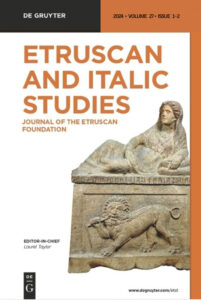
Etruscan and Italic Studies: Journal of the Etruscan Foundation is the leading English-language scholarly publication devoted to Etruscology and Italic Studies. The journal details activity in all areas of research and study related to Etruscan and pre-Roman Italy and publishes articles as well as reviews of meetings, exhibitions, and publications of interest to the professional community.
Boards
Board of Directors
P. Gregory Warden, President
Michael Thomas, Vice President
Peter Cinelli, Treasurer
Cecile Graziano, Secretary
Jack Giraudo
John Hopkins
Lisa Kressbach
Anthony Tuck
Honorary Trustees
Elizabeth Bartman
Elizabeth Bracher
Francesca Cinelli
Kerry K. Chartkoff
Kenneth B. Katz
Erik O. Nielsen, Emeritus
Wendy Walker
Angela Caveness Weisskopf
Executive Director
Jason Bauer
Honorary Advisors
Gilda Bartoloni
University of Rome-La Sapienza
Italy
Alexandra Ann Carpino
University of Northern Arizona
Arizona
Richard De Puma, Emeritus
University of Iowa
Iowa
Adriano Maggiani
University of Venice
Italy
Helen Nagy, Emerita
University of Puget Sound
Washington
Erik Nielsen, Emeritus
Franklin University
Switzerland
Annette Rathje
University of Copenhagen
Denmark
Giuseppe Sassatelli
University of Bologna
Italy
David Soren
University of Arizona
Arizona
Simonetta Stopponi
University of Perugia
Italy