
Lectures
Cinelli Annual Lecture
Friday, April 10
Penn Museum
3260 South Street Philadelphia, PA
Gretchen Meyers is Professor of Classics and Assistant Dean of Strategic Initiatives at Franklin & Marshall College in Pennsylvania (USA). A specialist in the archaeology of ancient Italy, her research focuses on Etruscan gender, ceremonial textile production, and Etrusco-Roman monumental architecture. She has served as Director of the American Academy in Rome’s Classical Summer School and as Editor in Chief of Etruscan and Italic Studies (2018–2020). Meyers is the Director of Materials for the Mugello Valley Archaeological Project and is currently completing a monograph on the Etruscan site of Poggio Colla for the University of Texas Press.
Sacred Threads: How Ancient Etruscan Women Wove Meaning Through Cloth
Imagine walking into an Etruscan tomb where painted walls shimmer with images of richly colored fabrics—crimson shrouds, gold-bordered mantles, and intricately patterned robes that seem to shimmer with life. These aren’t mere decorations. They are windows into a society where cloth carried profound meaning.
Etruscan women—renowned throughout the ancient world for their exceptional weaving skills—used textiles as a language of power, identity and ritual. Through visual analysis of painted tombs, sculpted sarcophagi, and ceremonial urns, Professor Gretchen Meyers will demonstrate how every fold, border, and texture in these ancient artworks tells a story of social bonds, sacred ceremonies, and female authority.
Offering a unique perspective on how material culture shapes civilization, this lecture will reveal the Etruscan world through the eyes of its most skilled artisans: the women who transformed wool and linen into instruments of social and sacred power. Professor Meyers shows us how Etruscan women literally wove the fabric of society together—thread by thread.
Stay in touch
Stay updated on events, publications, and fellowship opportunities.
Lecture Archives
- 2025
- 2023-24
- 2021-2022
- 2020-2021
- 2020-2021
- 2018-2019
- 2017-2018
- 2016-2017
- 2015-2016
- 2014-2015
- 2013-2014
- 2012-2013
- 2011-2012
- 2010-2011
- 2009-2010
- 2008-2009
- 2007-2008
- 2006-2007
- 2005-2006
- 2004-2005
- 2003-2004
- 2002-2003
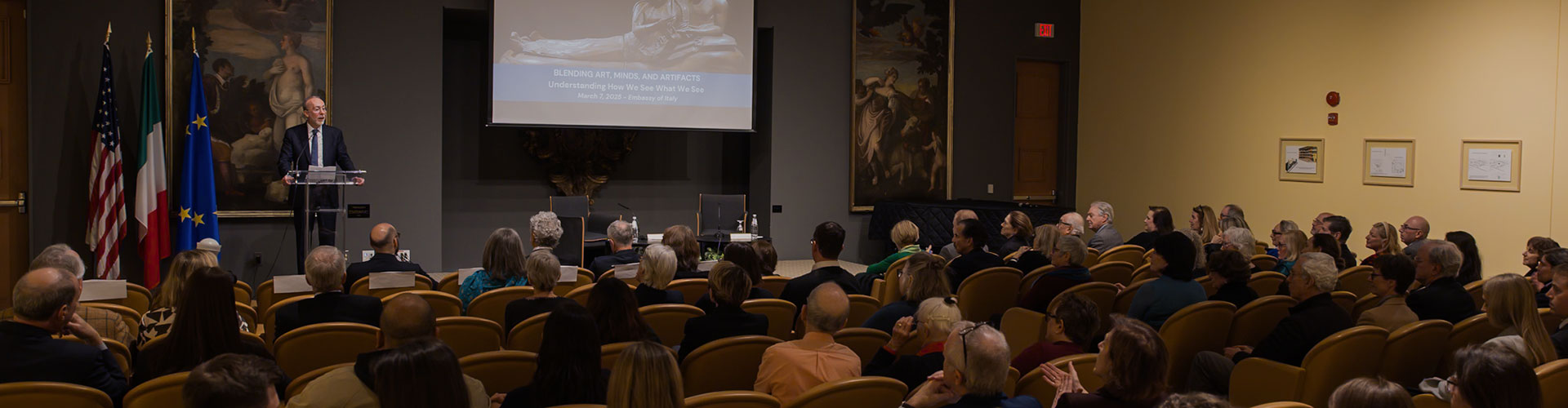
2025 Cinelli Lecture
March 7, 2025
Embassy of Italy, Washington, DC
Blending Art, Minds, and Artifacts: Understanding How We See What We See
Maurizio Forte, Ph.D., Duke University
Using AI tools like neural networks, we can rethink archaeological sites and monuments as ever-changing rather than fixed objects, evolving each time they are observed and interpreted. This lecture looked at how art, archaeology, and artificial intelligence come together, focusing on how our minds perceive and understand ancient artifacts. It also explored how experiencing historic spaces can encourage cultural exchange. Examples include the famous Etruscan Sarcophagus of the Spouses (housed at the Museum of Villa Giulia in Rome), which has now been digitally reconstructed using AI models and brainwave (EEG) analysis to study how people respond to virtual simulations. By combining AI and biometric tools to measure engagement, this approach shows how technology can help us see the ancient world in new ways. Dr. Forte challenges us to think differently about what it means to view something, suggesting that seeing is an active process that creates rich, layered stories shaped by memory, context, and technology.
A pioneer in digital and cyberarchaeology, Maurizio Forte is the William and Sue Gross Distinguished Professor of Classical Studies Art, Art History, and Visual Studies at Duke University in Durham, North Carolina. Dr. Forte’s talk was followed by a discussion led by P. Gregory Warden, Ph.D., president of the Etruscan Foundation, who has worked in Mediterranean archaeology for over 50 years.
2024 Cinelli Lecture
April 5, 2024
Meadows Museum, Southern Methodist University
5900 Bishop Boulevard, Dallas, Texas
The Antefixa Project: Recovering Sacro-Creative Action and the Making of Gods in and Beyond Rome
John North Hopkins, Ph.D., New York University
Life in Ancient Italy was steeped in rich and varied religious practices. Temples and precincts were covered in images of gods and demigods, and votives and cult statues filled spaces of belief. But when an expansionist leadership in Rome began violent military campaigns and occupation of the lands around them, they took hold of these diverse and connected sacred traditions and deployed religion as a means to erase, assimilate and appropriate sacred and social life. This included the overwriting and taking of histories of knowledge and artistic production of Etruscan- and Latin-speaking peoples, often claiming them for Rome. In this talk, Prof. Hopkins considers these itinerant, often non-Roman maker communities before and during the early years of Roman occupation. They will present the urgent need to re-examine these worlds as well as a new and innovative initiative, the Antefixa Project, which is harnessing scientific and computational imaging methodologies to recover the contributions of communities that have been silenced but were essential to sacred life in ancient Italy.
John North Hopkins is associate professor of art history in the Department of Fine Arts and Institute of Fine Arts at New York University. Prof. Hopkins is the author of The Genesis of Roman Architecture, which won numerous accolades, including the 2018 Spiro Kostof Award from the Society of Architectural Historians. Prof. Hopkins was a recipient of the 2006 Etruscan Foundation Fieldwork Fellowship and the 2007 Rome Prize from the American Academy in Rome. Their most recent book, Unbound from Rome: Art and Craft in a Fluid Landscape, ca. 650-250 BCE, was released by Yale University Press in January 2024.
Thursday, December 2, 2021
AIA Society: Montreal, Canada
Uncovering The Place of Uni: Archaeological Excavations At The Ancient Etruscan Site of Poggio Colla In Italy
Ann Steiner, Ph.D.
Shirley Watkins Steinman Professor of Classics
Franklin & Marshall College
Thursday, February 11, 2020
AIA Society: Richmond, Virginia
University of Richmond
The Etruscan Helmets from Vetulonia: New Evidence for the Life of an Etruscan Soldier
Hillary Becker, Ph.D.
Assistant Professor of Classics
Binghamton University-SUNY
Monday, October 19, 2020
AIA Society: Kansas City/Lawrence
(Virtual Program)
Vulci: The New Urban Archaeological Excavations
Maurizio Forte, Ph.D.
Professor of Classical and Visual Studies
Duke University
Wednesday, September 26, 2018
AIA Society: Northern New Jersey (Montclair)
Montclair State University
Painting Etruscan Temples and Tombs
Claire L. Lyons, Ph.D.
Curator of Antiquities
J. Paul Getty Museum
Thursday, March 8, 2018
AIA Society: Cincinnati, Ohio
Cincinnati Art Museum
The Etruscan Stele of Vicchio
Rex E. Wallace, Ph.D.
Professor of Classics
University of Massachusetts Amherst
Thursday, March 23, 2017
AIA Society: Pittsburgh, Pennsylvania
Cathedral of Learning, University of Pittsburgh
The Earliest Gateway of Rome: Recent work at Sant’Omobono in the Forum Boarium
Nicola Terrenato, Ph.D.
Esther B. Van Deman Collegiate Professor of Roman Studies
University of Michigan
Monday, October 19, 2015
AIA Society: New York City
Friends of Italy (FAI), Casa Italiana Zerilli-Marimò
I Principi Etruschi di Murlo (The Etruscan Princes of Murlo)
Erik Nielsen, Ph.D.
President Emeritus
Franklin University, Lugano, Switzerland
Friday, March 13, 2015
AIA Society: San Diego, California
San Diego State University
Votive Terracottas in their Archaeological Context: The Case of Cerveteri
Helen Nagy, Ph.D.
Professor Emeritus
University of Puget Sound, Tacoma, Washington
Sunday, November 3, 2013
AIA Society: Milwaukee, Wisconsin
University of Wisconsin-Milwaukee
The Ever Elusive Etruscan Egg
Lisa Pieraccini, Ph.D.
The History of Art Department’s Visiting Scholar in Ancient Art
University of California, Berkeley
Tuesday, February 5, 2013
AIA Society: Nashville, Tennessee
Nashville Parthenon
Etruscan Faces: From the Symbolic to the Real
Alexandra Ann Carpino, Ph.D.
Professor of Art History and Chair of the Department of Comparative Cultural Studies
Northern Arizona University, Flagstaff, AZ
Thursday, November 3, 2011
AIA Society: Central Arizona Chapter
Arizona State University (Tempe Campus)
The Mysterious Sacred Spring of the Emperor Augustus
David Soren, Ph.D.
Regents Professor of Anthropology and Classics
University of Arizona
Thursday, December 2, 2010
AIA Society: Washington
Maggiano’s Restaurant, Washington, DC
Myths and Social Life in Etruscan Tombs: The Hellenistic Urns from Chiusi
Francesco de Angelis, Ph.D.
Associate Professor of Roman Art and Archaeology
Columbia University, New York
Thursday, December 3, 2009
AIA Society: Los Angeles, California
Getty Villa, 17985 Pacific Coast Highway, Pacific Palisades, California
Narrative, Myth, Society in the Early Etruscan Culture
Dr. Giovannangelo Camporeale
Presidente dell’Istituto di Studi Etruschi e Italici
Florence, Italy
Thursday, April 16, 2009
AIA Society: Rochester, New York
University of Rochester
Divination: Themes of Prophecy in Etruscan, Greek and Roman Art
Nancy T. de Grummond, Ph.D.
Professor
Florida State University
Tuesday, February 19, 2008
AIA Society: Dallas, Texas
Meadows Museum, Southern Methodist University, Dallas, Texas
The Art of Etruscan Art
Jocelyn Penny Small, Ph.D.
Rutgers University
Wednesday, March 14, 2007
AIA Society: Cleveland, Ohio
Cleveland Museum of Natural History
Etruscan Gold
Richard De Puma, Ph.D.
University of Iowa
Monday, October 10, 2005
AIA Society: Washington, DC
American University Faculty Club
Cult, continuity and cultural identity at the Etruscan settlement of Poggio Colla (Florence)
P. Gregory Warden, Ph.D.
Professor
Southern Methodist University
Wednesday, March 18, 2005
AIA Society: Boston, Massachusetts
Boston Museum of Fine Arts
The Singing Rugon
Anthony Tuck, Ph.D.
Professor
Tufts University
Thursday, October 28, 2003
AIA Society: Madison, Wisconsin
Etruscan Demons of the Underworld
Helen Nagy, Ph.D.
Professor
University of Puget Sound
Thursday, April 10, 2003
AIA Society: Detroit, Michigan
Inaugural lecture program of the Ferdinando and Sarah Cinelli Lecture in Etruscan and Italic Archaeology
The Forgeries of Etruscan Art
Richard De Puma, Ph.D.
Professor
University of Iowa